OEM Wiring Harness Manufacturing Process: 8 Steps from Wire Cutting to 100% Testing
OEM wiring harness manufacturing is the build-to-print production of a custom wire harness: the customer supplies the drawing and connector schedule, and the factory converts standard wires, terminals and connectors into a finished, 100% electrically tested assembly. A professional OEM harness line runs eight controlled steps — from automated wire cutting to full electrical testing — under workmanship standards such as IPC/WHMA-A-620.
Below is how Yueqing Chengli Electronic Technology Co., Ltd. runs that process for automotive, appliance and new-energy harness programs, plus the quality checkpoints B2B buyers should expect at each step.
Step 1 — Wire Cutting and Stripping
Automatic cut-and-strip machines cut each wire to drawing length (typical tolerance ±1–3 mm depending on length) and strip insulation without nicking strands. Machine-calibrated blade depth and pull-off tests on stripped ends prevent hidden strand damage that later becomes a field failure.
Step 2 — Terminal Crimping
Terminals are crimped on semi-automatic presses or fully-automatic crimping machines. A controlled crimp is verified by crimp height (micrometer, per terminal spec) and pull-off force (sampled per run); modern presses add crimp-force monitoring (CFM) to catch every anomalous crimp in real time.
Step 3 — Soldering and Ultrasonic Welding
Where drawings call for soldered splices or welded splices, solder pots or ultrasonic metal welding are used. Ultrasonic splicing produces a molecular bond without solder and is preferred for high-current battery and ground splices in EV harnesses.
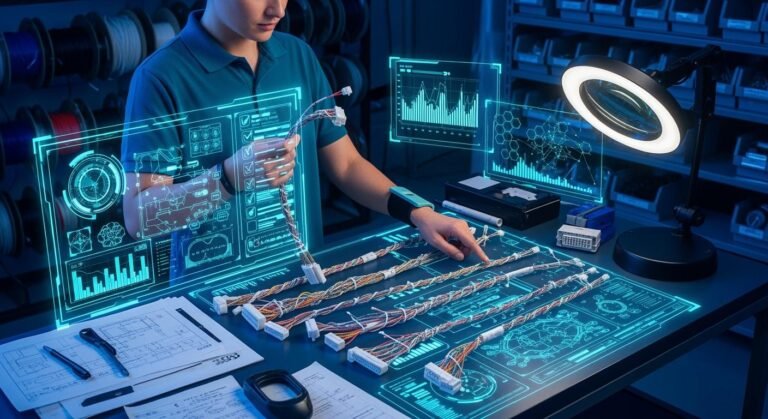
Step 4 — Assembly and Routing on Layout Boards
Wires are laid on a full-size assembly board (fixture) printed with the harness drawing. Operators route, insert terminals into connector housings (with TPA/CPA secondary locks checked), apply tape branches and sleeve positions exactly as drawn. The board is the first quality gate: a misplaced branch is caught before taping.
Step 5 — Protective Finishing
Harnesses receive their protection layers: PVC/electrical tape wraps, corrugated conduit (loom), braided sleeving, heat-shrink tubing at splices, and grommets where wires pass through panels. Material selection follows the environment — temperature class, abrasion, and fluid exposure.
Step 6 — 100% Electrical Testing
Every finished harness is tested on a continuity/hipot test board built to the drawing: point-to-point continuity, short-circuit between all circuits, and (for programs requiring it) dielectric withstand. A harness that has not passed 100% testing must never ship — ask any prospective supplier how they guarantee this.
Step 7 — Visual and Dimensional Inspection
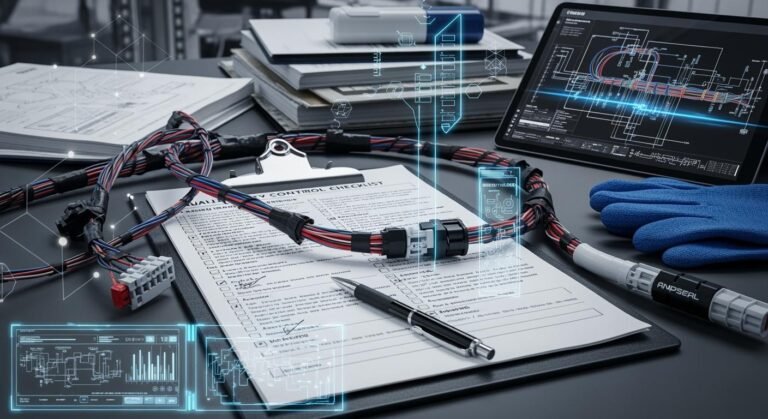
Workmanship is judged against IPC/WHMA-A-620 (the industry standard for cable and wire harness assemblies): crimp insulation support, conductor damage limits, tape overlap, sleeve shrink, connector latch condition, and label placement. Dimensional checks confirm overall length, branch lengths and connector orientations.
Step 8 — Packing and Traceability
Harnesses are coiled or packed to prevent deformation, labeled with part number and revision, and packed with lot traceability linking wires, terminal lots and test results — so any field issue can be traced to its material lot.
Quality Checkpoints Buyers Should Expect
| Checkpoint | Method | Reference |
|---|---|---|
| Crimp quality | Crimp height + pull-off force + CFM monitoring | IPC/WHMA-A-620, terminal spec |
| Splice integrity | Ultrasonic weld / solder inspection, pull test | IPC/WHMA-A-620 |
| Electrical function | 100% continuity + short + hipot on test board | Customer drawing |
| Workmanship | Visual inspection vs A-620 acceptance classes | IPC/WHMA-A-620 Class 1/2/3 |
| Traceability | Lot labels linking wire/terminal/test data | Factory QMS |
What to Ask an OEM Harness Supplier Before Placing an Order
- How is 100% electrical testing guaranteed — dedicated test boards per drawing, or universal testers?
- Which workmanship standard governs acceptance (IPC/WHMA-A-620 class)?
- What crimp process controls exist (crimp height, pull test frequency, CFM)?
- How are engineering changes (revision updates) controlled on the board and in test?
- What is the MOQ and sample/PPAP-style approval flow? (See our manufacturer audit checklist.)
Chengli builds custom OEM harnesses for auto manufacturing and equipment factories (B2B only, MOQ from 100 pcs). Compare our car wiring harness capabilities, learn the basics of wiring harnesses, or send your drawing for a 24-hour quote.