Fabricante de mazos de cables automotrices en China: 9 Criterios de auditoría para buscar un socio confiable
Fabricante de mazos de cables automotrices en China: 9 Criterios de auditoría para buscar un socio confiable
China is the world’s largest production base for automotive wire harnesses, and the range between capable manufacturers and assembly workshops is wider than in almost any other industry. This guide turns sourcing into a checklist: what an automotive wire harness manufacturer China should prove before you award a program, what documents carry real weight, and where the risk actually hides in a quotation.
Why China Remains the Default Sourcing Base for Harnesses
The automotive wire harness industry in China has scale advantages that are hard to replicate: a complete supply chain for wire, conectores, terminales, sleeving and tooling, mature process engineering, and a labor pool with decades of harness assembly experience. For custom programs with tight cost targets, a qualified Chinese manufacturer can deliver lead times and unit costs that few other regions match.
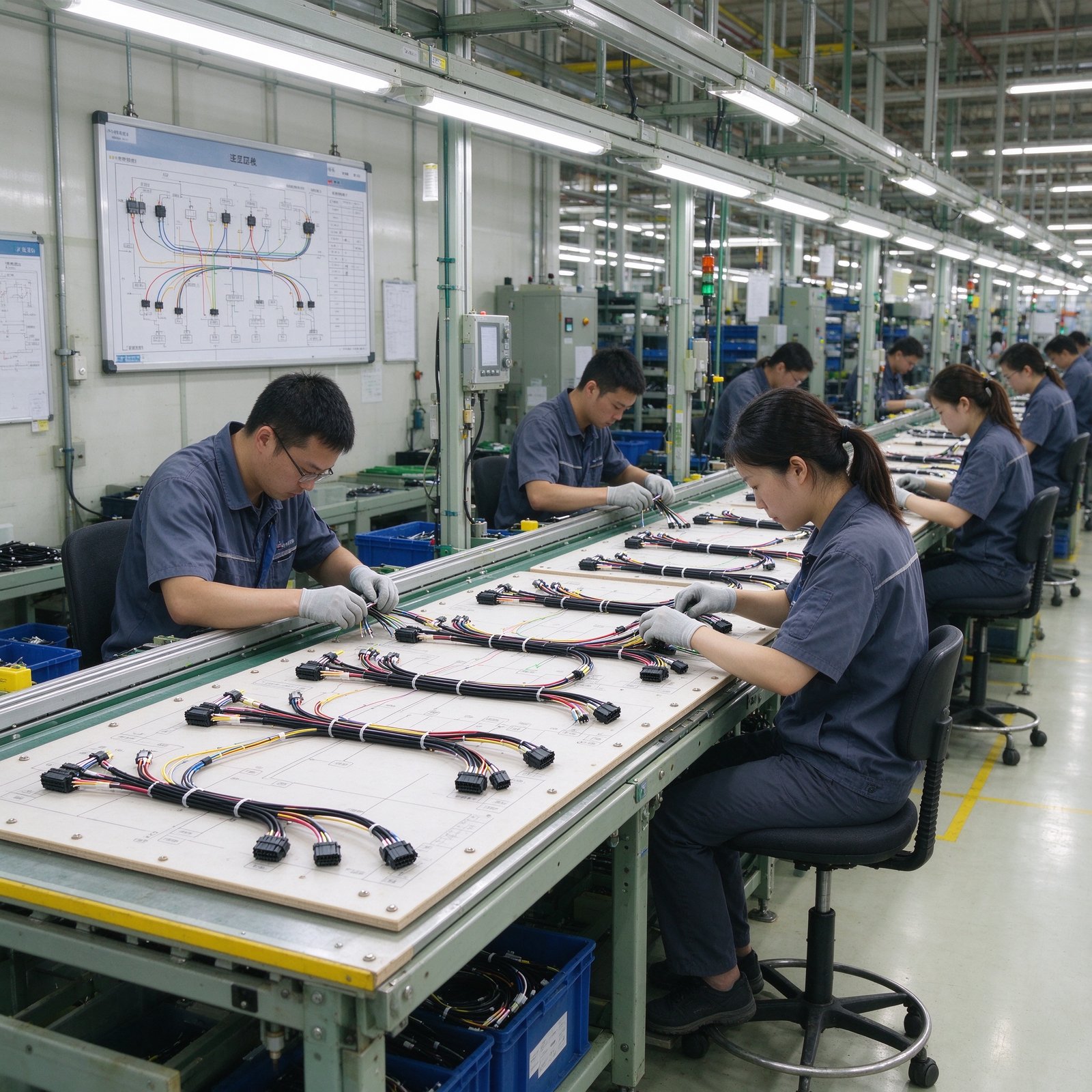
The scale cuts both ways. Because entry barriers are low, the market also contains small workshops that assemble on a formboard with no engineering, no process control and no test discipline. The sourcing challenge is not finding a Chinese supplier; it is proving that your chosen supplier is a manufacturer rather than a workshop.
Proceso de dar un título: The Baseline, Not the Answer
Every credible supplier claims certification, so the question is which certificates carry automotive weight. IATF 16949 is the automotive quality management system standard and is the first filter: a supplier without it is not set up for automotive-grade process control. ISO 9001 alone is a general baseline, not an automotive qualification.
Beyond the certificate, verify the scope and the audit history. An IATF 16949 certificate is issued against a defined scope, and the surveillance audits tell you whether the system is maintained or decorative.
Ask for the certificate scope and the most recent audit result, and verify the certificate directly with the certification body rather than accepting a copy. The traceability requirements are detailed in our IATF 16949 traceability guide.
Engineering Capability: Design Responsibility or Drawings Only?
The split between suppliers that build your drawings and suppliers that engineer your harness is the biggest quality differentiator. A build-to-print workshop produces what you specify and stops there; a manufacturing partner reviews the circuit, flags wire sizing, connector and routing risks, and returns a manufacturable, testable design.
Ask how the supplier handles engineering changes, prototype iteration and first article approval. The answers reveal whether you are buying capacity or buying competence, and for a body or engine harness with hundreds of circuits, competence is what protects you from design errors multiplied by volume.
The Production Floor: What the Line Actually Looks Like
A real harness manufacturer runs a controlled process: wire cutting and stripping on calibrated machines, crimping with validated dies and automatic monitoring, formboard assembly with documented routing, y 100 percent electrical test. A workshop runs cutters and crimpers with operator judgment and tests by sampling, if at all.
When you audit, look for the controls that matter: crimp quality monitoring (height, pull-out and cross-section checks), formboard accuracy and traceability, test equipment calibration, and the separation of good and defective material. The production floor is where the quality system becomes visible.
Crimp and Termination Quality Control
Crimping is the heart of harness reliability. Under IPC/WHMA-A-620, each crimp must meet defined acceptance criteria, and automotive programs should use validated die sets with in-process monitoring rather than relying on operator feel. Ask for the crimp qualification records and the cross-section analysis for your wire-connector combinations.
The practical check is whether the supplier can show you crimp pull-out data and micro-section results for the terminals you will actually use. If the qualification evidence is generic or missing, the harness will be only as good as the operator’s day.
Testing and Traceability
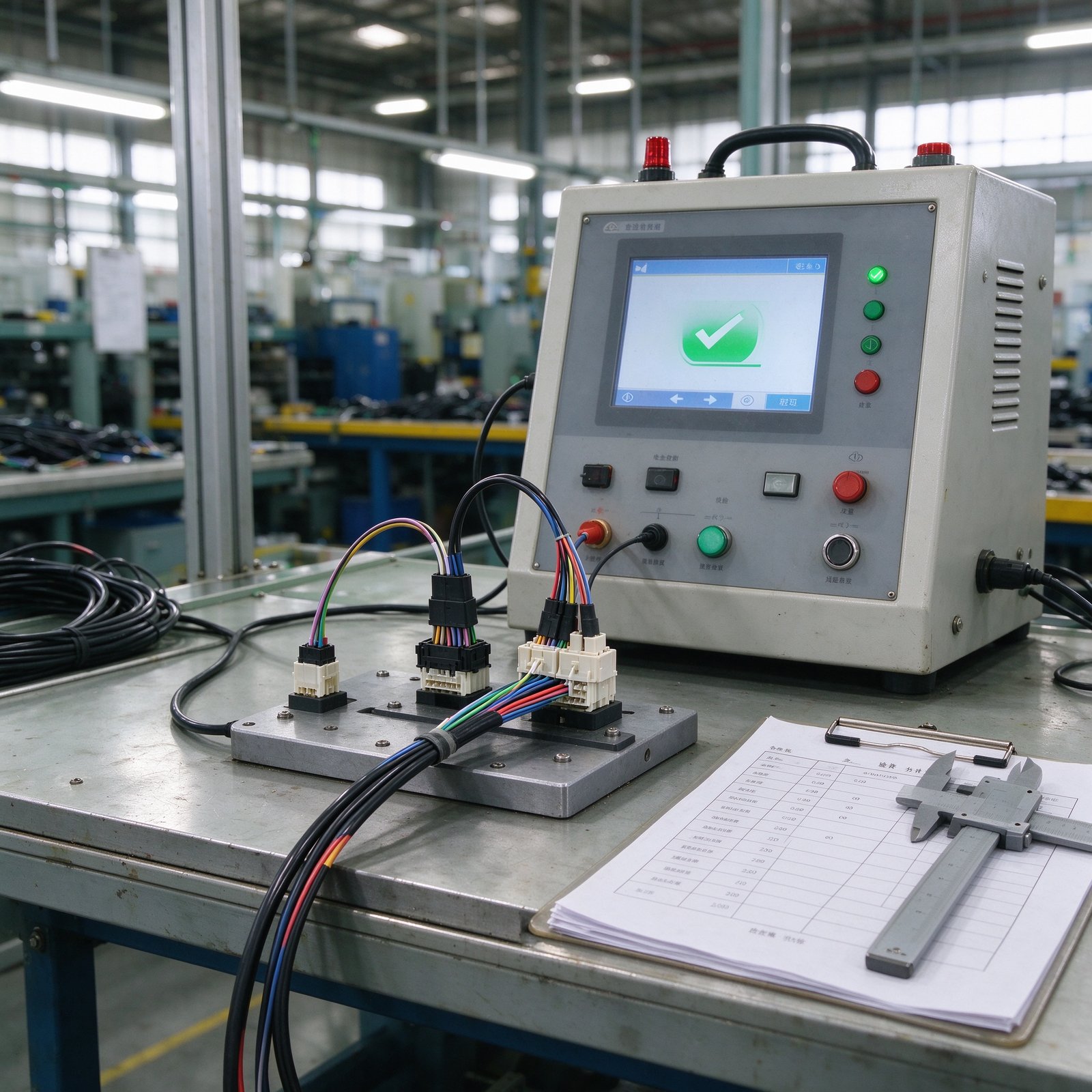
Automotive harnesses should be 100 percent electrically tested: continuity on every circuit, resistencia a aislamiento, and dielectric withstand where specified. The test results must be traceable to the harness serial or batch, so a field failure can be traced back to the production shift, the machine and the operator.
Ask how the supplier handles a failed harness at final test: rework, retest and the records of both. A supplier that records failures and root-causes them is running a closed quality loop; one that quietly reworks and ships is hiding the information you need.
Material Sourcing and Compliance
The wires, connectors and terminals in your harness should come from qualified sources, and the material compliance documents should be traceable: RoHS and REACH for Europe, UL for North American markets, and the automotive material requirements your OEM contract specifies. Ask for the material list with certificates rather than accepting a blanket compliance claim.
Material substitution is the quiet risk in Chinese sourcing. A quotation that saves money by switching connector grades or wire insulation can fail in the field and void your OEM contract. The supply agreement should freeze the approved material list and require approval for any substitution.
Communication and Program Management
Harness programs are detail-heavy and change often. The supplier’s engineering response time, the program management structure and the change control process decide whether a program ships on schedule or dies in a misunderstanding. Evaluate how the supplier handles an RFQ with engineering comments, a prototype with deviations, and a production change request.
A qualified partner assigns an engineer and a program manager who can discuss the harness in engineering terms, not just sales terms. The speed and accuracy of their responses to your technical questions is a reliable early indicator of the whole relationship.
Lista de verificación de auditoría de proveedores: 9 Criteria Before You Award
Before you award a harness program to an automotive wire harness manufacturer China, verify these nine items. Each one filters a different risk:
- 1. IATF 16949 certificate with scope and recent audit result, verified with the certifying body.
- 2. Engineering capability: design review, DFM feedback and change control process.
- 3. Production floor audit: controlled cutting, prensado, formboard assembly and test stations.
- 4. Crimp qualification with pull-out and cross-section records for your terminals.
- 5. 100 percent electrical test with traceability to harness batch and shift.
- 6. Approved material list with RoHS, REACH and UL documentation.
- 7. First article inspection process and prototype lead time.
- 8. Program management: named engineer and program manager, defined change control.
- 9. Reference list of automotive programs with contactable customers.
Working through these nine criteria before you commit converts sourcing from a price decision into an engineering decision, and that is the decision that protects your program. For the supplier selection angle, see our guide to finding a reliable automotive wiring harness supplier y el manufacturer audit checklist.
Preguntas frecuentes: Fabricante de mazos de cables automotrices en China
What certifications should an automotive wire harness manufacturer hold?
IATF 16949 is the automotive baseline for quality management; ISO 9001 is a general baseline. Verify the certificate scope and recent audit results with the certification body rather than accepting a copy.
How do I tell a real manufacturer from an assembly workshop?
Audit the floor: controlled cutting and crimping with validated dies, formboard assembly, 100 percent electrical test, material segregation and traceability. A workshop runs on operator judgment and sampling.
Why does crimp quality matter so much in automotive harnesses?
Crimps are the highest-risk electrical junction in a harness. Under IPC/WHMA-A-620 they must meet defined criteria, and automotive programs need validated dies with pull-out and cross-section qualification for reliability.
Should every circuit be electrically tested?
Sí. Automotive harnesses should be 100 percent continuity and insulation tested, with records traceable to the harness batch, shift and machine, so field failures can be root-caused.
How do I protect against material substitution in a quotation?
Freeze an approved material list in the supply agreement, require written approval for any substitution, and keep the compliance documents (RoHS, ALCANZAR, Ul) for every material on the list.
Contáctenos
Sourcing an automotive wire harness manufacturer China and want the qualification evidence reviewed? Send us your harness specification and program volume, and our engineering team will return the certification scope, capability summary and a free sample program for evaluation.
Refer to the Aichie Tech Electronics capability overview for an example of the certification and equipment profile a qualified Chinese harness manufacturer publishes.
