Automobilių kabelių surinkimas: Projektavimo ir testavimo paaiškinimas

Kad jūsų transporto priemonė būtų saugi ir sklandžiai eksploatuojama, priklausote nuo automobilių kabelių surinkimo konstrukcijos ir bandymų. Patikimi kabelių mazgai apsaugoti svarbias sistemas, tokias kaip oro pagalvės ir stabdžiai nuo elektros gedimų. Pažangios medžiagos ir sumani konstrukcija padeda šiems mazgams atsispirti karščiui, drėgmės, ir dėvėti.
Aukštos kokybės automobilių kabelių rinkinys palaiko greitą duomenų ir energijos srautą šiuolaikinėms funkcijoms.
Kruopštus bandymas ir reguliarus patikrinimas apsaugo nuo problemų, kurios gali kelti pavojų saugai.
Lengvas dizainas taip pat padeda jūsų automobiliui sunaudoti mažiau degalų ir pasirodyti geriau.
Pagrindiniai takeliai
Automobilių kabelių rinkiniai jungia svarbias transporto priemonių sistemas ir turi būti suprojektuoti naudojant tinkamas medžiagas ir konstrukciją, kad būtų galima valdyti šilumą, drėgmės, ir judėjimas.
Kabelių mazgų tikrinimas vizualiai, elektrinis, mechaninis, ir signalo vientisumo patikros padeda anksti rasti problemas ir užtikrina saugumą bei patikimumą.
Aiškių brėžinių naudojimas ir pramonės standartų laikymasis padidina gamybos tikslumą ir padeda kurti patvarus, aukštos kokybės kabelių rinkiniai.
Automatinės testavimo sistemos pagreitina patikrinimus, sumažinti klaidas, ir pateikti išsamius duomenis, kad pagerintumėte gamybą ir kokybės kontrolę.
Stiprus dizainas, kruopštus medžiagos pasirinkimas, ir kruopštus bandymas užtikrina, kad automobilių kabelių mazgai veiktų gerai, palaiko transporto priemonės saugumą ir pažangias funkcijas.
Automobilių kabelių surinkimo pagrindai

Kas yra automobilių kabelių mazgas
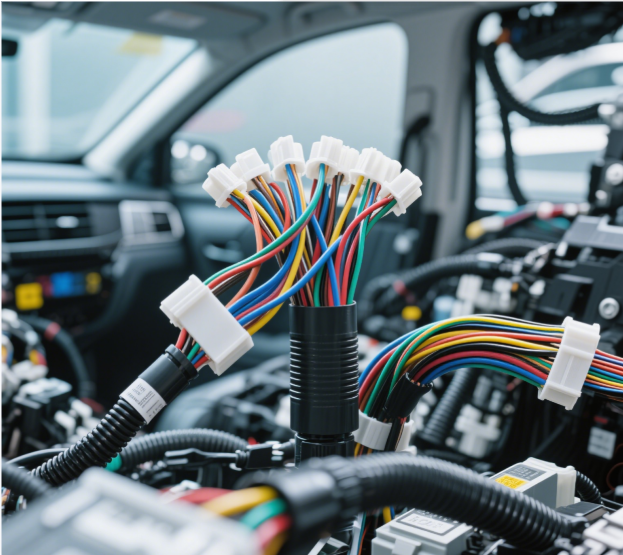
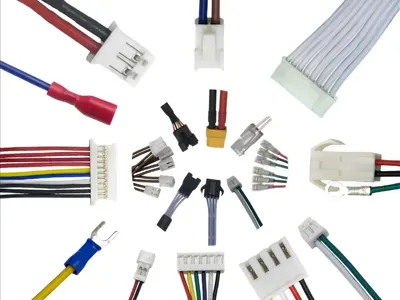
Kiekvienoje šiuolaikinėje transporto priemonėje rasite automobilių kabelių rinkinius. Šie mazgai padeda jūsų automobiliui siųsti energiją ir signalus svarbioms sistemoms. Kiekviename automobilių kabelių rinkinyje yra keletas pagrindinių dalių. Matai laidininkai, dažniausiai gaminamas iš vario, kurie neša elektrą ar duomenis. Iš stiprių polimerų pagaminti izoliatoriai apsaugo šiuos laidus nuo išorinių trukdžių. Jungtys sujungia skirtingas mazgo dalis, užtikrinti sklandų signalų srautą. Jūs taip pat pastebite apsauginė rankovė, kabelių raiščiai, ir spaustukai. Tai užtikrina, kad surinkimas būtų organizuotas ir apsaugotas nuo pažeidimų. Kai kuriuose mazguose naudojami antgaliai, kurie yra maži metaliniai vamzdeliai, kad vielos sruogos būtų kartu ir nesusidėvėtų.
PASTABA: Pramonės standartai, tokie kaip IPC/WHMA-A-620 ir SAE, nustato griežtas kiekvieno kabelio komplekto kokybės ir saugos taisykles.. Šie standartai padeda pasitikėti, kad kiekvienas mazgas gerai veiks jūsų transporto priemonėje.
Vaidmuo automobilių laidų pynėje
Automobilių kabelių rinkiniai atlieka pagrindinį vaidmenį automobilių laidų pynuose. Galite galvoti apie laidų rinkinį kaip apie ryšulį, kuris sujungia daugybę kabelių rinkinių į vieną tvarkingą įrenginį. Tai palengvina montavimą ir sutvarko jūsų automobilio laidus.
Laidai sujungia kabelius, laidai, ir jungtys kad atitiktų jūsų automobilio formą ir poreikius.
Ši integracija padeda jūsų automobiliui susidoroti su didelėmis srovėmis ir atsispirti karščiui ar vibracijai.
Jūs gaunate didesnį patikimumą ir mažesnę elektros problemų riziką.
Čia yra greitas palyginimas, kuris padės suprasti:
Aspektas | Aprašymas |
|---|---|
Automobilių kabelių mazgai | Laidų ir jungčių ryšuliai, skirti galiai perduoti, signalus, ir duomenis transporto priemonėse. |
Laidai | Struktūriniai kelių kabelių ir laidų ryšuliai, sujungti į vieną įrenginį, skirtą montuoti. |
Integracija | Laidų rinkiniai sujungia kelis kabelių rinkinius į vieną laidą, kad sutaupytumėte vietos ir būtų lengviau montuoti. |
Funkcija | Abu užtikrina patikimą elektros ryšį, palaiko saugos sistemas, ir įgalinti pažangias transporto priemonės funkcijas. |
Rezultatas | Integracija sukelia kompleksą, patvarus, ir efektyvūs elektros tinklai, pritaikyti transporto priemonių poreikiams. |
Kai žiūrite į savo transporto priemonės laidus, matote, kaip kabelių mazgai veikia kartu, kad viskas veiktų saugiai ir sklandžiai.
Kabelių mazgų projektavimas
Dizaino svarstymai
Kai pradedate projektuoti automobilių kabelių mazgus, reikia sutelkti dėmesį į kelis svarbius veiksnius. Kiekvienas jūsų priimtas sprendimas turi įtakos surinkimo veikimui ir trukmei jūsų automobilyje. Čia yra svarbiausi dizaino svarstymai, kuriuos turėtumėte atsiminti:
Anksti supraskite paraiškos reikalavimus. Tai padeda išvengti, kad surinkimas būtų per paprastas arba per sudėtingas savo darbui.
Pasirinkite tinkamą laidininko dydį. Dydis turi atitikti elektros apkrovą ir temperatūrą, kurioje dirbs mazgas.
Pasirinkite geriausią laidininko medžiagą. Varis ir vario lydiniai užtikrina gerą elektrinių savybių ir stiprumo pusiausvyrą.
Pagalvokite apie tai, kaip pastatytas laidininkas. Suvyti laidininkai, pvz., klojimas ryšuliu arba virvės klojimas, siūlo daugiau lankstumo ir geresnės ištvermės nei tvirti laidai.
Naudokite dengimą kaip skardą, sidabrinis, arba nikelio. Dengimas apsaugo nuo korozijos ir palengvina litavimą, ypač drėgnose ar karštose vietose.
Rinkitės aplinką atitinkančias izoliacines medžiagas. Gumos ir termoplastikai gali atlaikyti skirtingas temperatūras ir chemines medžiagas.
Pridėkite ekranavimą, jei reikia blokuoti elektromagnetinius trukdžius. Galite naudoti pynę, spiralė, arba folijos skydus, kad signalai būtų aiškūs.
Būtinai prijunkite ekraną prie jungčių abiejuose galuose. Tai užtikrina gerą skydo veikimą. 9. Norėdami pagerinti formą, naudokite užpildus ir juostas, stiprumo, ir mazgo atsparumas triukšmui.
Taip pat turite galvoti apie pasirinktinius kabelių rinkinius. Tai leidžia pritaikyti dizainą prie specialių poreikių, pvz., ankštos erdvės arba papildomas lankstumas. Jei norite, kad jūsų surinkimas truktų, turite apsvarstyti lankstus gyvenimas. Lankstus tarnavimo laikas reiškia, kiek kartų kabelis gali sulenkti prieš nutrūkdamas. Geras dizaino pasirinkimas padeda jūsų kabelių rinkiniams ištverti nuolatinį judėjimą ir vibraciją automobilio viduje.
Patarimas: Visada patikrinkite aplinką, kurioje įrenginys bus naudojamas. Šiluma, drėgmės, o cheminės medžiagos gali sutrumpinti jūsų kabelių sąrankų patvarumą, jei nepasirinksite tinkamų medžiagų.
Kabelių surinkimo brėžiniai
Jums reikia aiškių ir išsamių brėžinių, kad sukurtumėte kabelių rinkinius, kurie veiktų kiekvieną kartą. Profesionalus kabelio surinkimo brėžinys suteikia visą informaciją, kurios reikia tiksliam ir pakartotiniam gamybai. Štai ką rasite a tipinis piešinys:
Fizinis išdėstymas ir matmenys, įskaitant visą ilgį, šakų dydžiai, ir kur eina kiekviena jungtis.
Smeigtukai ir laidų detalės, parodydamas, kuris laidas jungiasi prie kurio kaiščio, vielos matuoklis, ir kaip laidai izoliuoti arba ekranuoti.
Medžiagų sąskaita (BOM) kuriame išvardytos visos dalys, nuo laidų ir jungčių iki etikečių ir rankovių.
Žingsnis po žingsnio surinkimo instrukcijos, įskaitant kokius įrankius naudoti ir kur patikrinti kokybę.
Kabelių tiesimo takai, parodyta, kaip mazgas turi būti sumontuotas transporto priemonėje, įskaitant lenkimo spindulius ir tvirtinimo taškus.
Kabelių valdymo detalės, pvz., kur įdėti kabelių jungtis, rankovėmis, ir apsauginius gaubtus.
Saugos pastabos ir įspėjamieji simboliai padės išvengti klaidų ir laikytis pramonės standartų.
Skaitmeniniai failai, kaip CAD brėžiniai ir PDF, padėti greitai bendrinti ir atnaujinti dizainą.
The lentelę žemiau parodo, kaip kiekviena brėžinio dalis padeda gauti nuoseklius gamybos rezultatus:
Piešimo elementas | Kaip tai padeda užtikrinti gamybos tikslumą ir nuoseklumą |
|---|---|
Pavadinimo blokas | Suteikia aiškią informaciją apie piešinį, pvz., dalies numeris ir peržiūra, todėl visada naudojate tinkamą versiją. |
Skalė | Rodo tinkamą dydį, taip išvengsite ilgio ar tarpų klaidų. |
Piešimo vaizdai | Leidžia pamatyti surinkimą iš skirtingų kampų, kad būtų lengviau suprasti ir sukurti. |
Simbolių biblioteka | Naudoja standartinius simbolius, todėl visi jūsų komandos nariai supranta tą patį. |
Laidų schemos | Parodo tiksliai, kaip prijungti laidus, laidų klaidų mažinimas. |
Laidų maršrutizavimas | Padės, kaip surišti ir pritvirtinti laidus, apsaugoti juos nuo pažeidimų. |
Informacija apie jungtį | Padeda teisingai suderinti jungtis ir laidus, vengiant susimaišymo. |
Laido identifikavimas | Naudoja etiketes ir spalvas, kad trikčių šalinimas ir surinkimas būtų greitesnis. |
Medžiagų sąmata | Išvardija visas dalis, todėl surinkimo metu nieko nepraleisite. |
Revizijos kontrolė | Seka pokyčius, todėl visada turite naujausią ir tiksliausią dizainą. |
Galite naudoti skaitmeninės duomenų bazės saugoti ir tvarkyti šiuos brėžinius. Tai leidžia greitai sukurti naujausią dizainą ir sumažinti rankinio duomenų įvedimo klaidų. Automatinės sistemos taip pat seka kokybės patikras ir padeda anksti pastebėti problemas, which improves the endurance and reliability of your cable assemblies.
Materials and Construction
The materials you choose for your cable assemblies decide how well they perform and how long they last. You need to pick materials that match the job and the environment. Čia yra a table showing common materials and their advantages:
Medžiagos tipas | Medžiaga | Privalumai |
|---|---|---|
Conductive Materials | Vario | Didelis elektros laidumas, lankstus, resists corrosion |
Aliuminis | Good conductivity, lengvas, helps reduce vehicle weight | |
Nickel-Chromium | Handles high temperatures, resists oxidation and corrosion | |
Copper-Nickel | Good conductivity, excellent corrosion resistance, works well in harsh environments | |
Insulation Materials | Teflonas (PTFE) | Handles high heat, resists chemicals, low friction |
Silikonas | Lankstus, resists high temperatures, common in automotive insulation | |
Polyimide (Kapton) | Stable at high temperatures, great electrical insulation | |
Shielding Materials | Copper Braiding | Strong EMI protection, lankstus, patvarus |
Aluminum Foil | Lengvas, good EMI shielding | |
Additional Examples | Xlpe | Protects against heat and shock, used in heavy-duty cables |
Tinned Copper | Resists corrosion, used in conductors |
When you build custom cable assemblies, you can select special materials to meet unique needs. Pavyzdžiui, you might use polyurethane for its flexibility and abrasion resistance, or thermoplastic elastomers for chemical and oil resistance. Overmolding with materials like Santoprene or PVC gives you extra protection against moisture and wear. This helps your cable assemblies survive tough conditions and keeps them working longer.
Material selection also affects the flex life and environmental resistance of your assembly. Silicone and cross-linked polyethylene handle high temperatures, while thermoplastic elastomers stay flexible in the cold. If you need your cable assemblies to last through many bends and twists, you must choose materials that support high endurance. Advanced materials like engineered fluoropolymers can handle extreme temperatures and chemicals, making them ideal for harsh automotive environments.
PASTABA: If you pick the wrong material, your cable assemblies may fail early, ypač drėgnose ar karštose vietose. Always match your material choice to the real-world conditions your assembly will face.
Cable Harness Testing Methods

Automotive cable harness testing helps you find problems before they cause failures in your vehicle. You use different tests to check the safety, patvarumas, and performance of each electrical cable harness. These methods help you make sure every cable assembly meets strict industry standards.
Visual Inspection
You always start cable harness testing with a careful visual inspection. This step lets you spot obvious problems before you move on to more advanced tests. You look for damage, poor workmanship, and missing parts. You also check if the cables are routed correctly and if connectors are seated properly. High-resolution images help you find small gaps or misalignments that are hard to see with the naked eye.
Here is a table that shows the main steps and tools you use during visual inspection:
Inspection Aspect | Procedure / Kriterijai | Tools / Methods Used | Quantifiable Metrics / Standartai |
|---|---|---|---|
Checklist Design | Itemized checks by harness ID (Pvz., izoliacija, terminal oxidation) | Checklist with embedded metrics | Mating force: 20-50N; example pass: 38N |
Photo Documentation | Capture overview and close-up images of anomalies | Naming convention: DeviceID_HarnessID_Date | – |
Assistive Technologies | AI image analysis for aging detection (92% accuracy), RFID tracking for inspection history | AI models, RFID scanners | – |
Insulation Integrity | Visual check for cuts/cracks, magnifiers/endoscopes for hidden areas | Magnifiers, endoscopes | Wear <10% thickness reduction: monitor; cracks >0.5mm: replace |
Aging and Deformation | Tactile hardness evaluation, thermal imaging for overheating signs | Thermal imager | Replace if yellow discoloration or bulging detected |
Environmental Damage | Check for chemical corrosion (pH test strips), biological damage (rodent marks) | pH test strips, visual inspection | – |
Connector and Terminal | Clean oxidation with ethanol, check deformation, insertion/extraction force testing | Ethanol swabs, force testers, OEM drawings | Replace gold-plated terminals with >30% oxidation |
Mating Performance | Measure insertion/extraction forces, verify locking clicks | Digital torque gauges | Typical force: 20-50N; replacement after rated cycles |
Sealing Verification | Air-tightness tests for waterproof connectors, inspect rubber gaskets | Pressure tests (0.5Bar), visual inspection | Leakage <5% in 30s for IP67+ connectors |
Mechanical Structure | Check cable ties/clips for breakage/looseness, maintain clearance from moving parts | Visual inspection | ≤2mm displacement allowed; ≥50mm clearance recommended |
Environmental Adaptability | High-temp oven test (125°C/24h), low-temp flexibility test (-40°C), simulated rain and dust tests | Oven, bending tests, humidity sensors | Insulation crack inspection post-test; humidity ≤85%RH |
Inspection Cycles | Routine every 10,000 km or 6 months; after extreme conditions; NEV high-voltage wiring insulation tests | Scheduled maintenance, condition-based inspections | Insulation resistance tests every 3 months for NEV wiring |
During visual inspection, you often find these common defects:
Improper cable routing that can lead to pinching or damage
Misaligned or loose connectors, which may cause poor electrical connections
Missing screws, making parts loose or unsafe
Subtle defects like small connector gaps or slight misrouting
Wire deformities, such as bends or damage
Incorrect crimp placement or loose crimps
Birdcaging, where wires splay out instead of staying bundled
Insulation defects like cracks, fraying, or discoloration
Contact points with visible defects
You also check that insulation covers the wire beyond the crimp tab and that all enclosures are secure. This step in cable harness testing helps you catch problems early and avoid costly repairs later.
Elektriniai bandymai
After visual inspection, you move to electrical cable harness testing. These tests help you make sure the harness works safely and reliably. You use several types of electrical tests to check for breaks, shorts, and insulation problems.
Here is a table showing the main electrical tests and their purposes:
Bandymo tipas | Tikslas |
|---|---|
Verifies uninterrupted electrical flow through wires, ensuring secure connections. | |
Insulation Resistance Test | Measures insulation quality by applying high voltage and checking resistance to leakage. |
High Voltage (Dielectric) | Tests harness ability to withstand voltages above normal operating levels without failure. |
Funkcinis testavimas | Simulates actual operation to confirm overall harness performance and component integration. |
Contact Resistance Test | Measures resistance at connectors to ensure good conductivity and detect poor crimps. |
Short Circuit Test | Detects accidental wire contacts that could cause shorts, verifying proper assembly. |
You use continuity testing to check that every wire in the harness has a complete path. This test sends a small electrical signal through each wire. If the signal does not reach the end, you know there is a break. You repeat continuity testing for every wire to make sure the electrical cable harness has no interruptions.
Insulation resistance tests help you find leaks between wires and insulation. You apply a high voltage and measure how much current leaks through the insulation. Good insulation keeps the current low. If you find high leakage, you replace the harness.
Aukštos įtampos (hipot) tests push the harness to handle voltages higher than normal. This test helps you find weak spots in the insulation that could fail under stress. Contact resistance tests check the quality of crimps and connectors. Low resistance means a good connection. High resistance means you need to fix or replace the part.
You also run functional tests to simulate real-world use. You check if the harness can transmit power and data as needed. These tests help you confirm that the electrical cable harness will work in your vehicle.
Other important electrical cable harness tests include:
Flame resistance tests to check fire safety
EMC and shielding tests to prevent electromagnetic interference
You use these tests to make sure your cable harness testing covers every possible risk.
Mechanical and Environmental Testing
You need to know that your cable harness can survive tough conditions. Mechanical and environmental tests help you check the strength and durability of each electrical cable harness. These tests show how the harness will perform in real-world automotive environments.
Here is a table of common mechanical and environmental tests:
Test Category | Test Name / Tipas | Tikslas / Aprašymas |
|---|---|---|
Mechanical Tests | Pull Tests (pull and break, pull, hold and break, pull and hold, pull and release) | Evaluate cable strength and connector durability under tensile forces. |
Flex/Bend Test | Assess cable performance under bending, twisting, and flexing to ensure signal integrity during movement. | |
Verify cable’s ability to withstand mechanical shocks without damage. | ||
Insulation Concentricity and Wall Thickness | Measure insulation uniformity and thickness to ensure quality and durability. | |
Environmental Tests | Thermal Shock | Test cable resilience to rapid temperature changes. |
Waterproofness (IP66/IP67) | Confirm protection against dust and water ingress under specified conditions. | |
Humidity | Assess cable performance under high moisture conditions. | |
Vibracija | Evaluate cable durability under mechanical vibrations. | |
High/Low Temperature Storage | Test cable stability and performance after exposure to extreme temperatures. | |
Fungus Exposure (Fungal Resilience Test) | Ensure resistance to fungal growth in warm, humid, or marine environments. | |
Druskos purškiklis | Assess corrosion resistance due to salt exposure. | |
Chemical and Fluids Exposure | Test cable resistance to various chemicals and fluids. | |
Immersion Leak Detection | Verify seal integrity and airtightness to prevent fluid leakage. |
You use pull tests to check how much force the harness can handle before breaking. Flex and bend tests, like the Tick-Tock Tester, simulate the bending and twisting that cables face in a moving car. These tests help you see if the harness can keep its signal integrity during constant movement.
Heat resistance tests use temperature chambers to expose the harness to extreme heat and cold. You want to know if the insulation cracks or if the cable loses strength. Vibration and impact resistance tests show if the harness can survive bumps and shocks on the road.
You also test for waterproofness by submerging the harness and checking for leaks. Salt spray and chemical exposure tests help you see if the harness can resist corrosion. These mechanical and environmental tests make sure your cable harness testing covers every challenge your vehicle might face.
Signal Integrity Testing
Modern vehicles use advanced electronics that need clean, reliable signals. Signal integrity testing helps you make sure your electrical cable harness can transmit data without distortion or loss. You use several tests to check for problems like interference, signal loss, and timing errors.
Key signal integrity tests include:
Impedance testing, which checks if the cable impedance matches the required value. This test is critical for high-frequency signals.
EMI and EMC testing, which help you find and fix electromagnetic interference problems.
Insertion loss and return loss measurements, which show how much signal is lost or reflected.
Crosstalk tests, which check if signals from one wire interfere with another.
Propagation delay and time skew tests, which measure how fast signals travel and if they stay in sync.
Here is a table showing important figures of merit for signal integrity tests:
Figure of Merit | Aprašymas | Importance |
|---|---|---|
Insertion Loss | Attenuation of signal from input to output, measured in dB | Indicates signal attenuation; ideal is 0 dB |
Return Loss | Loss due to signal reflections from impedance mismatches, in dB | Measures signal reflection, affecting integrity |
Crosstalk | Unwanted signal coupling from adjacent wiring, in dB | Indicates interference between lines |
Propagation Delay | Time taken for signal to travel through the cable | Affects timing and synchronization |
Time Skew | Time difference between signals on multiple lines | Critical for multi-lane data transmission synchronization |
You use oscilloscopes, vector network analyzers, and other advanced tools to run these tests. These tools help you find problems with timing, jitter, and noise. You also use signal integrity tests to check if your cable harness can support high data rates and low voltages, which are common in new vehicles.
Advanced cable assemblies, like Eye Speed micro coax and twinax cables, show low insertion loss and minimal timing skew. These features help you maintain signal integrity even at high speeds. Good signal integrity testing helps you avoid data errors and keeps your vehicle’s electronics running smoothly.
Patarimas: Always include signal integrity tests in your cable harness testing plan. These tests help you catch problems that can affect advanced automotive electronics, such as timing errors and data loss.
By following these cable harness testing methods, you make sure your electrical cable harness meets all safety, patvarumas, and performance standards. You protect your vehicle from failures and keep every system running as it should.
Automation in Testing
Automated Test Systems
You can make your cable harness testing faster and more reliable by using an automated electrical cable harness testing system. These systems use advanced tools and software to check every wire and connection in your harness. Here are some common parts you will find in an automated electrical cable harness testing system:
Hipot testers check insulation resistance and high-voltage safety.
Multi-point switching systems handle many test points at once, making it easy to test complex harnesses.
Automation software controls the whole process, runs test sequences, logs data, and finds faults quickly.
With an automated electrical cable harness testing system, you can run tests like continuity, insulation resistance, and ground bond checks. The system uses relay matrices and software to apply voltage, measure current, and spot problems much faster than manual testing. You can also use scripting to automate workflows and connect the testing system to other machines in your factory. This approach helps you test every wire, even in large and complex harnesses, with high testing accuracy.
Patarimas: Automated cable testing can reduce test times from hours to just minutes, even for harnesses with hundreds of connections.
Benefits of Automation
When you use an automated electrical cable harness testing system, you get many benefits that improve your production process. Here is a table showing how automation helps you:
Nauda | How It Helps You |
|---|---|
Improved Quality & Accuracy | Reduces human error and ensures repeatable, precise testing results. |
Increased Efficiency | Runs complex test sequences quickly, saving you time and boosting productivity. |
Data Management & Traceability | Records all test data for quality checks and future tracking. |
Saugumas | Keeps workers safe by enclosing high-voltage tests and reducing manual handling. |
Adaptability | Handles complex harness designs for electric and advanced vehicles. |
Cost Reduction | Cuts labor costs and waste, making your production more competitive. |
You can also track every step of the process with automated systems. Gamybos vykdymo sistemos (Mes) assign unique codes to each harness, record test results, and link them to specific machines and workers. This traceability helps you find and fix problems fast, manage recalls, and meet industry standards. Automation also helps you keep up with changing customer needs and supports just-in-time production.
By using an automated electrical cable harness testing system, you make your cable harness testing more accurate, greičiau, and safer. You also collect valuable data that helps you improve quality and stay ahead in the automotive industry.
Applications and Compliance
Real-World Applications
You see automotive cable assemblies everywhere in modern vehicles. These assemblies help your car send power and signals to important systems like lights, engines, radios, ir jutikliai. They keep your vehicle running safely and smoothly, even when facing heat, šalta, drėgmės, or chemicals. Different types of cables, such as XLPE-insulated and PVC-insulated wires, match the needs of each system. Pavyzdžiui, battery cables handle high power, while shielded cables protect sensitive electronics from interference.
Here are some key ways cable assemblies work in your vehicle:
Electrification increases wiring complexity and weight, especially in electric cars.
Autonomous driving needs extra wiring and backup systems for safety and reliability.
Artificial intelligence adds more sensors and control units, all connected by complex harnesses.
Connected vehicles use special cables for infotainment and communication networks.
You might find iki 40 harnesses, 700 jungtys, ir 3,000 laidai in a single car. Each assembly supports a different function, from engine control to door locks. The table below shows how different harnesses serve your vehicle:
Type of Wire Harness | Application in Vehicle |
|---|---|
Engine Wire Harness | Connects battery, alternator, jutikliai; handles heat and vibration. |
Chassis Wire Harness | Powers lights, ABS sensors, suspension modules. |
Body Wire Harness | Runs sound systems, interior lights, and safety features. |
Door Wire Harness | Controls power windows, locks, and mirrors; built for flexibility. |
Dashboard Wire Harness | Powers speedometer, warning lights, GPS, and entertainment. |
Powertrain Wire Harness | Links transmission, engine, starter, and alternator for smooth operation. |
You also rely on cable assemblies for advanced driver-assistance systems (ADAS) and infotainment. Ethernet, CAN, and fiber optic cables help transfer data quickly between sensors, cameras, and control units. These connections keep your vehicle safe and connected.
Standards and Quality
You need strong standards and quality assurance to keep automotive cable assemblies reliable. International standards guide every step of design and manufacturing. The ISO 19642 series covers vocabulary, design rules, and test methods for many types of cables. ISO 6722 ir ISO 4141 focus on single-core and multi-core cables. ISO 6856 sets rules for ignition cable assemblies. ISO 19453 covers environmental testing for electric vehicles. These standards help you trust that each assembly meets strict requirements for safety and performance.
Standard Series / Number | Pavadinimas / Scope | Fokusavimo sritis |
|---|---|---|
ISO 19642 series | Automotive cables—design guidelines, test methods, requirements for copper and aluminum cables | Design and testing of automotive cables |
ISO 6722 series | Single-core cables—dimensions, test methods, requirements | Single-core cable design/testing |
ISO 4141 series | Multi-core connecting cables—test methods, requirements, construction | Multi-core cable design/testing |
ISO 6856 | Unscreened high-voltage ignition cable assemblies—test methods, requirements | Ignition cable assemblies |
ISO 19453 series | Environmental conditions and testing for electric vehicles | Environmental testing |
You also see quality management systems like ISO 9001 ir IATF 16949 in action. These systems help suppliers set goals, improve processes, and meet customer needs. IATF 16949 builds on ISO 9001 and focuses on continual improvement, defect prevention, and reducing waste. Tier 1 suppliers must have IATF 16949 sertifikavimas, while others start with ISO 9001. These standards require you to use tools like APQP, FMEA, and PPAP for quality assurance. They help you deliver consistent, high-quality assemblies that keep vehicles safe and reliable.
Patarimas: Following these standards and quality systems helps you avoid costly recalls and ensures your assemblies meet the highest safety and performance levels.
You gain lasting value when you focus on strong design and testing for automotive cable assemblies. These steps help you meet strict standards, improve reliability, and reduce failures.
Use advanced testing, patinka burn-in and vibration checks, to find weaknesses early.
Choose materials and designs that match your needs and environment.
Industry leaders use dedicated QA rooms, lean manufacturing, and modular design to keep quality high. When you follow these best practices, you build assemblies that last and perform well in every vehicle.
DUK
What is the difference between a cable assembly and a wire harness?
A cable assembly groups wires together with connectors and protective covers. A wire harness organizes many cable assemblies into one bundle. You use cable assemblies for specific tasks. You use wire harnesses to connect many systems in your vehicle.
How often should you test automotive cable assemblies?
You should test cable assemblies during production and before installation. You also need to check them during regular vehicle maintenance. Testing helps you find problems early and keeps your vehicle safe.
Why do you need shielding in automotive cables?
Shielding blocks electromagnetic interference (EMI). You use shielding to protect signals from outside noise. This keeps your car’s electronics working without errors or data loss.
What tools help you test cable assemblies?
You use tools like multimeters, hipot testers, and automated test systems. These tools check for breaks, shorts, and insulation problems. Automated systems also record test results for quality control.
Can you repair a damaged cable assembly, or should you replace it?
You can repair minor damage, like a loose connector or small insulation nick. For major damage, such as broken wires or burned insulation, you should replace the assembly. This keeps your vehicle safe and reliable.