Wire Harness Quality Inspection: 5 Stages Buyers Should Verify
When a harness reaches an assembly line with the wrong wire, loose terminal, missing seal, or damaged branch, the cost appears far beyond the inspection station. A structured wire harness quality inspection plan helps buyers separate incoming-material checks, process checks, elektrische Tests, and final visual review. The plan should be tied to the drawing revision and the risks of the actual application.
What Are the Main Stages of Wire Harness Quality Inspection?
A useful inspection system follows the product through the factory rather than waiting until the final packing table. Incoming checks confirm materials, in-process checks confirm assembly, and final checks confirm the completed harness against the approved specification.
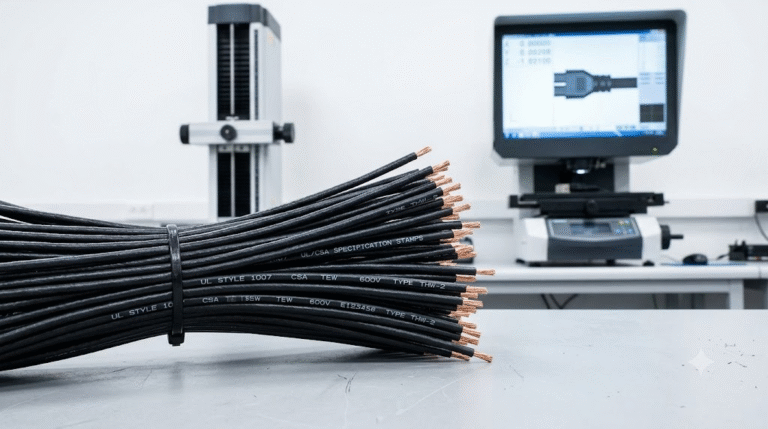
- Incoming inspection: Check wire, Terminals, Anschlüsse, Siegel, Etiketten, and revision-controlled materials.
- First-article inspection: Compare the first approved build with the drawing, Probe, bill of materials, and assembly method.
- Process inspection: Check stripping, Crimpen, Einfügen, locking, Routenführung, Verzweigung, and protection during production.
- Final inspection: Confirm appearance, dimensions, electrical results, marking, Verpackung, und Rückverfolgbarkeit.
For a workmanship reference, Käufer können die konsultieren WHMA-Erklärung zu IPC/WHMA-A-620. The specific acceptance class and customer specification must still be agreed for the harness being inspected.
How Does Drawing Control Affect Inspection?
The drawing revision controls what the inspector is checking. If the inspection sheet, work instruction, Testprogramm, and material list refer to different revisions, a supplier can record a clean result against the wrong product definition.
Before production, compare the part number, Kabelspezifikation, Ansicht des Steckerhohlraums, Terminal, Siegel, branch length, label, and customer notes. Keep the approved sample or drawing available at the station where the inspection occurs.
- Part identity: Confirm model, Revision, viel, and order reference.
- Material identity: Match wire, Terminal, Stecker, Siegel, and label details.
- Geometry: Confirm branch lengths, Routenführung, orientation, und Schutz.
- Test definition: Confirm continuity, hypot, Isolierung, or other required checks.
Which Defects Should a Buyer Ask the Supplier to Track?
Inspection becomes useful when defects are described precisely enough to trigger a controlled action. “Bad harness” is not a root cause; “terminal not fully locked in cavity 4” or “seal missing at connector X” gives the team a checkable problem.
- Wrong wire color, Messgerät, Länge, or material.
- Incomplete or damaged crimp, exposed conductor, or incorrect terminal height.
- Terminal not fully inserted, secondary lock not engaged, or seal missing.
- Incorrect branch route, bend, Clip, grommet, label, or protective sleeve.
- Offener Stromkreis, unexpected connection, failed insulation, or failed dielectric result.
The corrective-action record should identify containment, affected lots, suspected cause, Überprüfung, and disposition. A supplier that only replaces the visible piece without checking the process may leave the same defect in the next shipment.
How Should Electrical Tests Fit into Quality Inspection?
Electrical tests answer specific questions and should not be used as a substitute for physical inspection. Continuity can identify opens and unexpected paths, hipot can assess dielectric separation under an approved condition, and insulation resistance can provide evidence about separation behavior under its own method.
For every test, request the approved instruction, test-point definition, equipment or fixture reference, result record, and failure-handling process. The report should connect the outcome to the harness part number, Revision, viel, Probe, or other traceable identity.
How Can a Custom Harness Supplier Support Inspection?
Wenn wir ein maßgeschneidertes Geschirr überprüfen, we clarify the application, drawing, wire and connector details, expected quantity, inspection points, and required documents before production. This helps our technical team convert a buyer’s requirements into an inspection sequence that operators can follow.
Yueqing Chengli Electronic Technology Co., Ltd. liefert maßgeschneiderte Kabelbäume für die Automobilindustrie, Gerät, Neue Energie, und Industriemaschinenanwendungen. Our available company information references ISO 9001, Iatf 16949, Ul, CE, RoHS, und REACH; buyers should confirm the exact documents applicable to their project.
For electrical evidence, vergleiche die Anleitung zur Durchgangsprüfung von Kabelbäumen and the wire harness hipot test guide. For terminal workmanship, Überprüfen Sie die Anleitung zum Crimpen von Kabelbäumen.
Checkliste für Lieferantenaudits: 5 Inspection Records to Request
- Kontrollierte Zeichnung und Stückliste: verifies the product definition used by production.
- Incoming inspection record: confirms material identity and acceptance.
- First-article or sample report: shows that the first build was compared with the approved requirements.
- Process inspection checklist: shows how crimping, Einfügen, locking, Routenführung, and protection are checked.
- Final test and corrective-action records: connect release decisions to electrical results and defect handling.
Wire Harness Quality Inspection FAQ
Q: Should quality inspection happen only after the harness is finished?
NEIN. Incoming, first-article, process, and final checks catch different risks. Waiting until the end can make the cause harder to locate and increase rework.
Q: What makes an inspection record useful?
It should identify the part, Revision, lot or sample, inspection point, result, and disposition when something fails. A checklist without traceability is difficult to use for corrective action.
Q: What should I provide for a custom inspection plan?
Provide the drawing or sample, bill of materials, Anwendungsumgebung, Steckerdetails, Mengen, test requirements, and acceptance documents. Our technical team can use these inputs to define the inspection sequence.
Für einen Brauch wire harness quality inspection planen, Kontaktieren Sie Yueqing Chengli Electronic Technology Co., Ltd. bei chl0002@yqchlidz.com oder WhatsApp +44 7835 413019.