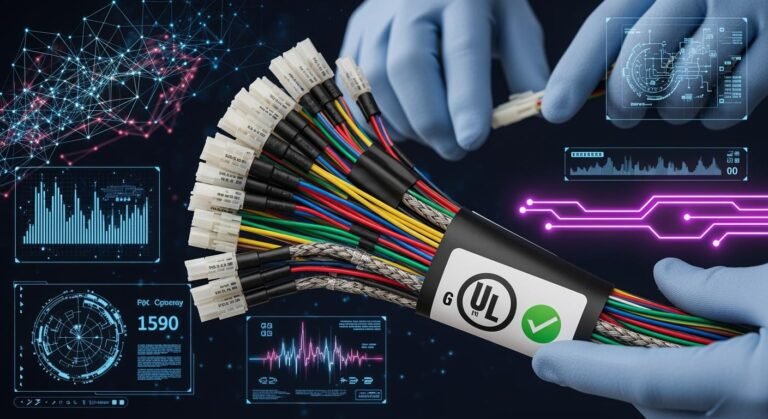
Wire Harness Wire Gauge Selection: 5 Critical Design Checks
If a harness becomes warm, causes a voltage-sensitive device to reset, or fails after a long cable route is installed, the conductor selection deserves review. 실용적인 wire harness wire gauge selection process considers load current, route length, voltage drop, 온도, 묶음, 격리, terminal compatibility, and the application’s documentation. Choosing by current alone can leave an OEM with a harness that works on the bench but does not fit the real installation.
What Does Wire Gauge Mean in a Harness?
Wire gauge describes conductor size through a defined sizing system such as AWG or metric cross-sectional area. A larger conductor generally offers lower resistance, but the usable choice also depends on insulation, terminal capacity, routing space, 온도, and the connector family.
For a custom harness, the wire is not selected in isolation. The conductor, 단말기, 밀봉하다, 커넥터 캐비티, crimp tooling, 지점 레이아웃, and protective material must work as one assembly. The approved drawing should state the required wire and interface rather than leaving the decision to an informal substitution.
Which Factors Matter in Wire Harness Wire Gauge Selection?
Start with the electrical load and then add the physical and environmental constraints. The same current can create a different result in a short open route than in a long bundled route with limited heat dissipation.
- Current: Identify continuous, intermittent, and inrush conditions instead of using only a nominal label value.
- 길이: Include the complete electrical path when assessing resistance and voltage drop.
- 온도: Consider ambient temperature, nearby heat, duty cycle, and insulation rating.
- 동고: Account for grouped conductors and reduced heat dissipation inside a loom or enclosure.
- Mechanical fit: Check bend radius, terminal barrel, 커넥터 캐비티, 물개, 클립, and available space.
For workmanship and process expectations, 구매자는 IPC/WHMA-A-620에 대한 WHMA 설명. The applicable project class and acceptance requirements still need to be agreed between buyer and supplier.
How Does Voltage Drop Change the Selection?
Every conductor has resistance. As route length and current increase, the voltage available at the load can fall. That drop can reduce actuator performance, affect sensors, increase heat, or create an intermittent condition that is difficult to reproduce during a short sample test.
Use the approved electrical design method to calculate the expected drop for the complete circuit. Do not insert a generic percentage or current table into a customer drawing without checking its source, conductor material, temperature assumption, and one-way versus loop length.
- Confirm supply voltage and the load’s acceptable operating range.
- Confirm current at normal, peak, and start-up conditions.
- Confirm one-way length and the return path.
- Confirm conductor material, 크기, 온도, and installation route.
- Validate the result with the connector and terminal ratings.
What Problems Can the Wrong Gauge Create?
An undersized conductor can increase resistance and temperature. An oversized conductor can create different problems, including an incompatible terminal barrel, excessive bend stiffness, crowded connector cavities, larger bundle volume, and a change that was never approved by the design owner.
The safest corrective action is not to replace wire based on appearance. Trace the electrical requirement, terminal compatibility, 단열 시스템, 라우팅, 및 고객 문서. If a substitution is necessary, record the reason and verify the complete assembly again.
How Can a Custom Harness Supplier Support Gauge Selection?
맞춤형 하네스를 검토할 때, we ask for the application, load information, route length, 환경, 커넥터 제품군, sample or drawing, 수량, and required inspection records. These inputs allow our technical team to separate a wire-size question from a connector or routing question.
Yueqing Chengli Electronic Technology Co., Ltd. 자동차용 맞춤형 하네스 공급, 기구, 신에너지, 및 산업 기계 애플리케이션. Our available company information references ISO 9001, IATF 16949, ul, CE, RoHS 규제, 도달하다; 구매자는 특정 프로젝트에 어떤 문서가 적용되는지 확인해야 합니다..
Before approving the conductor plan, compare our 와이어 하니스 핀아웃 검토 가이드 그리고 와이어 하네스 커넥터 유형 가이드. Those checks help connect gauge selection with the actual connector interface.
공급업체 감사 체크리스트: 5 승인 전 요청서류
- Approved wire specification: verifies gauge, conductor, 격리, and revision.
- Load and route information: shows the design inputs used for current and voltage-drop decisions.
- Terminal and connector compatibility record: confirms the selected wire fits the interface.
- Environmental requirement: identifies temperature, 묶음, 움직임, 수분, or chemical constraints.
- Change or deviation record: documents any approved substitution and revalidation.
Wire Harness Wire Gauge Selection FAQ
큐: Is current the only input for wire gauge selection?
아니요. Current is one input. Route length, voltage drop, 온도, 묶음, 격리, terminal compatibility, mechanical fit, and application requirements also affect the decision.
큐: Can a larger wire always replace a smaller wire?
아니요. A larger conductor may not fit the terminal barrel or connector cavity and may change routing or bend behavior. Any substitution should be reviewed and documented.
큐: What should I send for a custom gauge review?
도면이나 샘플 보내기, load conditions, route length, supply voltage, 환경, 커넥터 세부정보, 수량, 및 필수검사서류. Our team can then review the complete assembly rather than only the conductor.

관례를 위해 wire harness wire gauge selection 검토, Yueqing Chengli Electronic Technology Co.에 문의하세요., Ltd. ~에 chl0002@yqchlidz.com 또는 whatsapp +44 7835 413019.