Wire Harness Continuity Test: 5 Critical Checks Before Approval
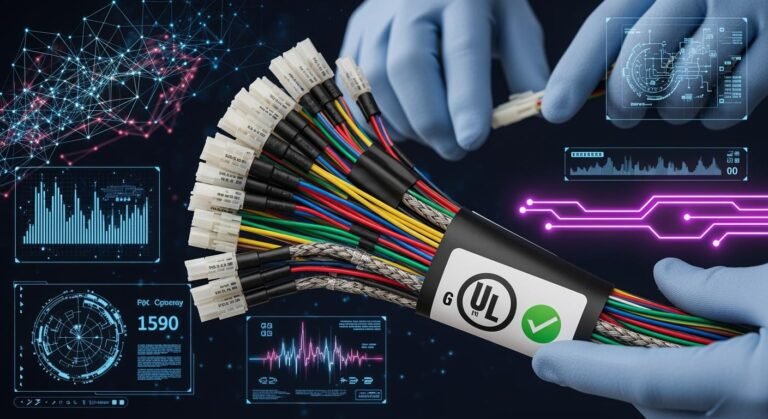
If a finished harness shows an open circuit, the fastest fix is not always to replace the whole assembly. A controlled wire harness continuity test helps you locate missing connections, wrong pin assignments, loose terminals, and intermittent paths before a harness reaches an appliance, vehicle, energy system, or industrial machine. The useful result is not only pass or fail; it is a traceable decision about what to inspect next.
What Does a Wire Harness Continuity Test Actually Confirm?
A continuity test checks whether an intended electrical path is present between defined points. The test can help identify an open circuit, a missing terminal, an incorrect cavity connection, or a conductor that is not connected to the expected endpoint.
Continuity is not the same as proving every aspect of harness quality. A circuit may show a path and still have an incorrect pinout, weak mechanical retention, insulation damage, or a resistance value that is unsuitable for the application. The wiring diagram and customer acceptance criteria must remain the reference.
How Should You Prepare a Wire Harness Continuity Test?
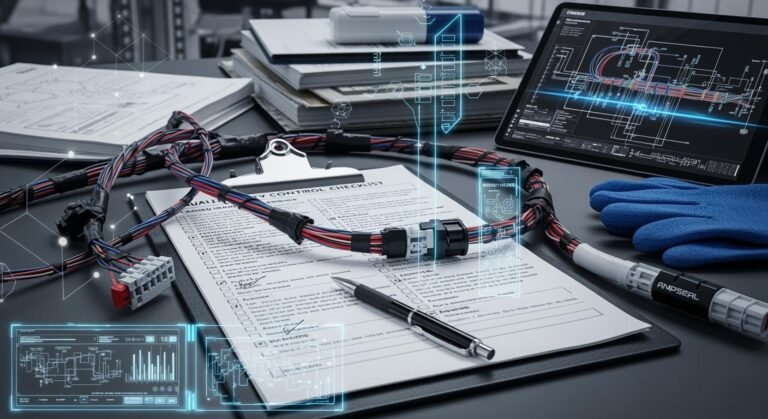
Start with the latest drawing revision, connector cavity view, wire list, and test-point definition. If the test program is based on an old revision, a technically correct harness can be reported as wrong or a real wiring error can be missed.
- Confirm the reference: Match the harness part number and revision to the approved drawing.
- Define the endpoints: Identify the connector cavities, terminal, splices, and branches that should be connected.
- Check the interface: Use the correct connector adapters and verify that the fixture does not force a terminal out of position.
- Protect the sample: Avoid test connections that bend, tarik, or damage the harness under inspection.
For a broader workmanship reference, buyers can review the WHMA explanation of IPC/WHMA-A-620. The applicable acceptance class and customer specification still need to be agreed for each project.
How Should You Read Continuity Test Results?
A failed point should be connected to a physical inspection step. Check the cavity number, terminal position, conductor route, splice location, and drawing revision before assuming that the wire itself is defective.
For repeat production, the report should identify the harness part number, revision, lot or sample reference, test status, and the operator or system record required by the customer. A result without traceability is difficult to use when a quality question appears later.
- Open circuit: Inspect the conductor route, crimp, terminal seating, and splice.
- Unexpected connection: Check crossed wires, damaged insulation, fixture contact, or an incorrect cavity.
- Intermittent result: Inspect movement, connector locking, terminal retention, and test-fixture contact.
- Unexpected resistance: Compare the result with the approved specification instead of applying a generic limit.
When Is Continuity Testing Not Enough?
A continuity result does not by itself prove insulation separation, dielectric withstand, environmental durability, or long-term mechanical retention. Those questions may require additional inspection or validation defined by the application.
Contohnya, a harness for an appliance may have different risks from a harness installed in a moving vehicle or an energy system. The test plan should follow the operating environment, connector design, voltage requirements, movement, moisture exposure, and customer documentation.
How Can a Custom Harness Supplier Support the Test?
When we prepare a custom harness from a sample or technical drawing, we recommend confirming the application, wire specification, connector family, branch layout, and inspection expectations before production. This gives the test process a controlled connection map rather than an informal checklist.
Yueqing Chengli Electronic Technology Co., LTD. supplies customized harnesses for automotive, appliance, new-energy, and industrial equipment applications. Our documented quality-system information includes ISO 9001, IATF 16949, UL, CE, RoHS, and REACH references; the exact requirement for your project should be confirmed during technical review.
Before sampling, compare the test points with our wire harness pinout review guide. For assembly-related checks, our wire harness crimping process guide explains why a continuity result should be connected to terminal and tooling inspection.
Supplier Audit Checklist: 5 Records to Request Before Approval
- Approved wiring diagram: verifies the intended circuit and revision.
- Continuity test-point list: shows which endpoints and connections are being checked.
- Fixture or adapter identification: helps confirm that the test interface matches the connector.
- Test report sample: demonstrates how results are linked to a harness, lot, or sample.
- Nonconformance and corrective-action record: shows how failed circuits are contained and investigated.
Wire Harness Continuity Test FAQ
Q: Can a continuity test detect a wrong pin assignment?
It can identify an unexpected connection when the test program includes the correct endpoints and isolation checks. It cannot correct an outdated drawing or an incorrect test fixture, so the test map must be reviewed first.
Q: Does continuity testing prove that a crimp is mechanically strong?
No. Continuity confirms an electrical path at the time of testing. Mechanical retention and crimp acceptance require the inspection or validation methods specified for the terminal, wire, and application.
Q: What should I send for a custom harness review?
Send the latest drawing or sample, connector and terminal information, wire specification, application environment, quantity, and required inspection documents. This allows our technical team to define a practical test map before quotation.
For a custom wire harness continuity test review, contact Yueqing Chengli Electronic Technology Co., LTD. at chl0002@yqchlidz.com or WhatsApp +44 7835 413019.