Wire Harness Hipot Test: 5 Essential Safety Checks
If a harness passes a continuity check but the equipment still needs insulation or voltage validation, a wire harness hipot test may be part of the approved test plan. Hypot, or dielectric withstand testing, is used to assess insulation separation under a specified test condition. It is not a replacement for continuity, pinout, Pemeriksaan visual, or application-specific validation.

What Does a Wire Harness Hipot Test Check?
A hipot test applies a defined electrical stress between conductors or between a conductor and an intended reference such as a shield or ground, depending on the approved test method. The purpose is to evaluate whether insulation separates the circuits under that condition.
The test voltage, duration, connections, leakage criteria, ramp behavior, and discharge procedure cannot be selected safely from a generic blog rule. They must come from the product design, customer specification, applicable standard, and the capabilities of the test equipment.
How Is Hipot Different from a Continuity Test?
A continuity test asks whether intended electrical paths are connected. A hipot test asks whether insulation separates defined electrical parts when the specified test stress is applied. The two tests answer different questions and should not be treated as interchangeable.
- Kesinambungan: Helps locate opens, missing terminals, wrong connections, and unexpected paths.
- Hypot: Helps assess dielectric separation under the approved test condition.
- Insulation resistance: Measures resistance behavior under its own specified method and limits.
- Pemeriksaan visual: Finds damage, penghalaan, penyambung, seal, and workmanship issues that an electrical test may not explain.
For manufacturing workmanship context, buyers can consult the WHMA overview of IPC/WHMA-A-620. It describes the standard’s role in materials, processes, pemeriksaan, and acceptance; the exact test plan still depends on the project.
How Should You Prepare a Hipot Test for a Harness?
Begin with the approved schematic and identify which conductors are tested together, which are isolated, and where shields or grounds are connected. A wrong grouping can create a misleading result or place stress on a component that was not intended to be tested in that way.
- Confirm the circuit map: Match conductor groups to the latest drawing revision.
- Confirm equipment setup: Check the fixture, adapters, interlocks, and test-lead condition.
- Confirm the approved parameters: Use the customer or standard-based test instruction rather than an assumed value.
- Control access: Define who may start the test and how discharge or failed samples are handled.
ISO 9001 describes the importance of controlled processes, documented information, performance evaluation, and continual improvement in a quality management system. Its official ISO 9001 reference is useful when buyers assess how a supplier controls test records and corrective actions.
How Should Buyers Interpret Hipot Results?
A pass or fail should be tied to the approved test instruction, sample identity, and equipment record. If a sample fails, do not assume that the insulation material alone is responsible. Inspect routing, stripped ends, connector cavities, seals, damage, contamination, and test-fixture contact.
Repeat testing also needs control. Repeated electrical stress, an unapproved retest method, or a damaged sample can make later results difficult to interpret. The supplier should document the failure, containment decision, investigation, and disposition according to the customer’s quality process.
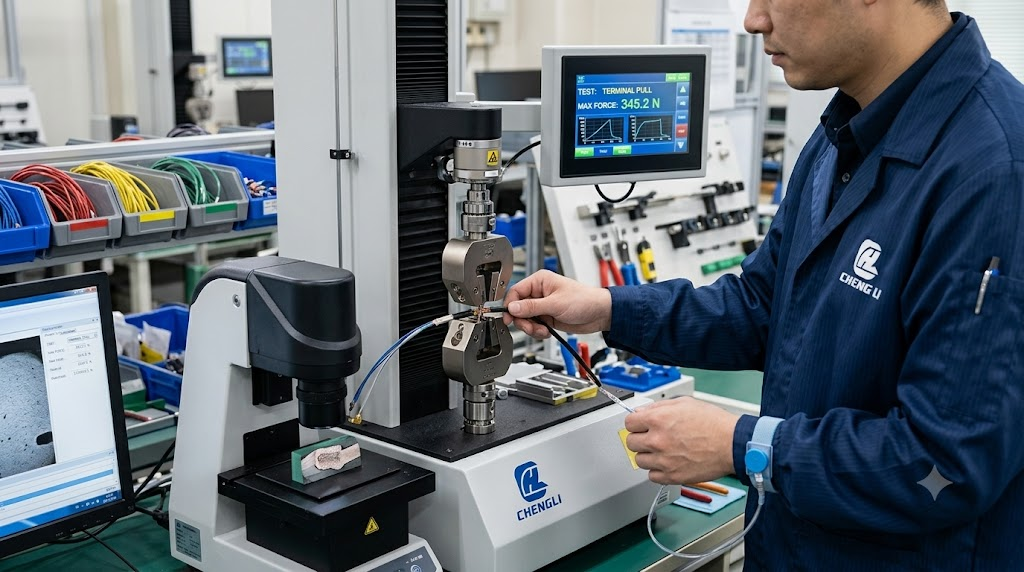
When Is a Hipot Test Not the Whole Validation Plan?
A hipot result does not prove connector locking, crimp retention, bend performance, abrasion resistance, temperature behavior, or moisture durability. Those risks need their own design review or validation where the application requires it.
Automotif, appliance, new-energy, and industrial equipment harnesses can have different voltage, movement, enclosure, and service conditions. We recommend defining the test plan from the real operating environment instead of copying a value from an unrelated harness.
How Can a Custom Harness Supplier Support Hipot Readiness?
When we review a custom harness, we first clarify the drawing, conductor grouping, connector family, application environment, quantity, and required certification or inspection documents. That information helps our technical team separate a design question from a test-record question.
Yueqing Chengli Electronic Technology Co., LTD. provides customized harnesses for automotive, appliance, new-energy, and industrial machinery applications. The company information available for this content plan references ISO 9001, IATF 16949, UL, CE, RoHS, dan REACH; buyers should confirm which documents apply to their specific project.
Before approving the electrical test plan, review our wire harness continuity test guide for circuit-map preparation. For physical connection risks, compare the wire harness crimping process guide.
Supplier Audit Checklist: 5 Hipot Records to Request
- Approved test instruction: verifies the test method and project-specific parameters.
- Circuit grouping or schematic: shows which conductors are tested against each other.
- Equipment and fixture record: identifies the test system and connection interface.
- Sample test report: shows how results are linked to a part, revision, and lot.
- Failure investigation record: demonstrates how failed samples are contained and analyzed.
Wire Harness Hipot Test FAQ
Q: Is a hipot test the same as a continuity test?
No. Continuity checks intended electrical paths, while hipot checks insulation separation under an approved electrical stress. A harness may require both tests because they address different failure risks.
Q: Can I copy hipot settings from another harness?
Not safely without technical approval. Test parameters depend on the circuit design, insulation system, applicable requirements, and equipment. Ask the supplier to show the approved source for each setting.
Q: What should a buyer request after a failed hipot result?
Request the failed sample identity, test record, containment decision, investigation, and corrective-action evidence. The record should explain what was checked before a replacement sample is accepted.
For a custom wire harness hipot test review, contact Yueqing Chengli Electronic Technology Co., LTD. at chl0002@yqchlidz.com or WhatsApp +44 7835 413019.