Dây nịt dây điện cao thế EV: Thiết kế kiến trúc 800V
Xe điện chuyển từ kiến trúc 400V sang 800V trong vài năm qua, tăng gấp đôi điện áp hệ thống để cho phép sạc nhanh hơn, cáp nhẹ hơn và tầm xa hơn. That transition changes every design rule for an EV high voltage wiring harness: cách nhiệt, che chắn, connector sealing, service disconnect, touch protection and EMC all move up a tier.
This guide explains what 800V changes in a high-voltage harness, how engineers specify components, and what buyers should look for in an EV wire harness manufacturer.
Why 800V Matters for the Harness
At the same power, higher voltage means lower current. Lower current means:
– Thinner cables (less copper, less weight)
– Less heat in the harness
– Faster DC charging (350 kW+ chargers become practical)
– Smaller connectors and busbars
But 800V also raises new engineering challenges:
– Partial discharge and corona risk at the insulation level
– Touch protection under all service conditions
– EMC interference from high di/dt switching
– Connector arc-flash behavior on disconnect
– Isolation resistance monitoring
The harness is the spine of the 800V vehicle; its failure mode is safety-critical.
High-Voltage Harness Components
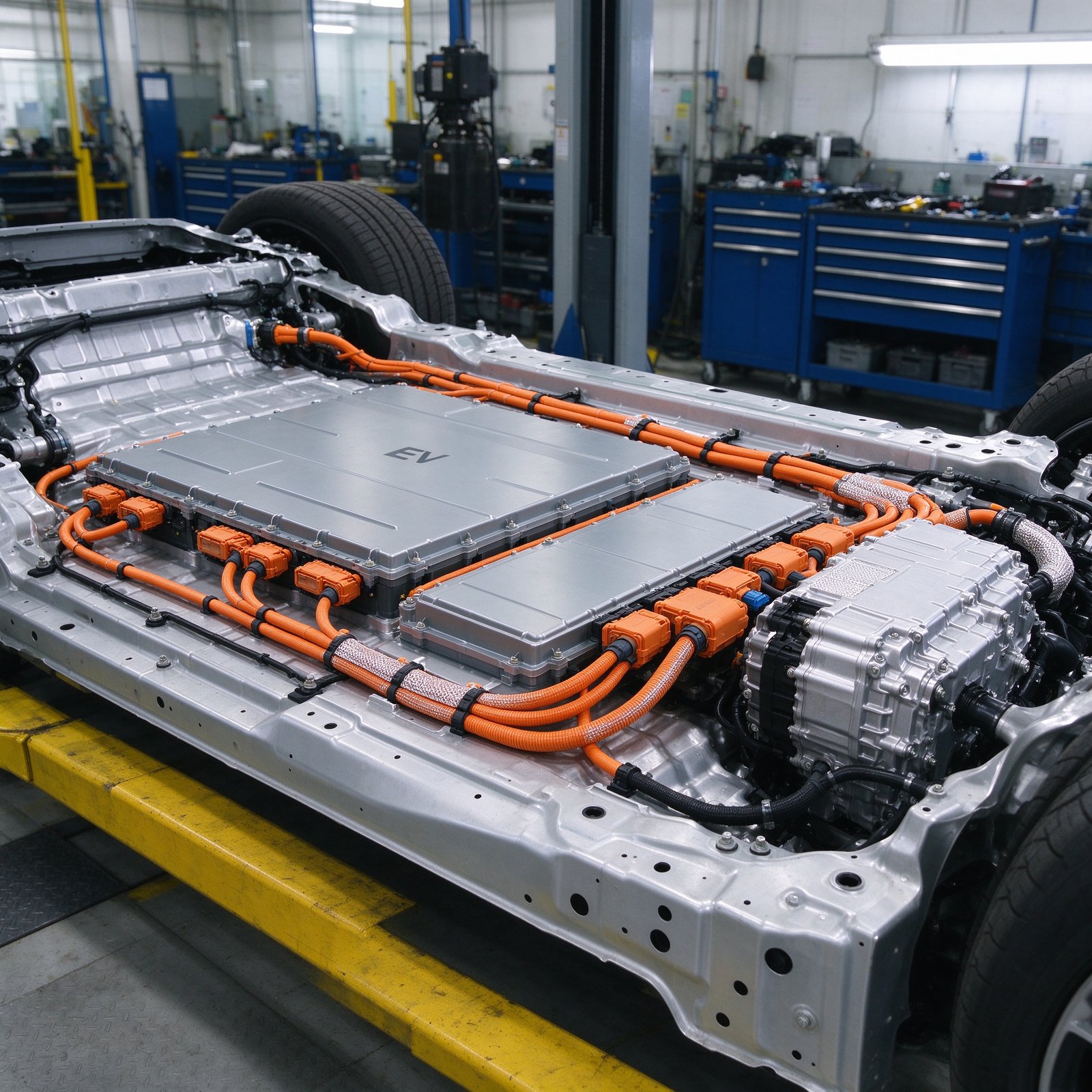
An EV high-voltage harness connects the battery pack, motor inverter, onboard charger, DC-DC converter and thermal system. Key components:
| Thành phần | Chức năng |
| HV cables | Silicone or XLPE insulation, orange jacket, shielded |
| HV connectors | Bịt kín, shielded, with high-voltage interlock loop (NGHỈ NGƠI) |
| Service disconnect (SDU) | Manual disconnect for service |
| Busbars | Where rigid connections replace cables |
| Routing and shielding | Around cabin, motor and inverter |
| Ground and bonding | Isolation monitoring reference |
The orange color of HV cables is not cosmetic; it is the visual signal that the circuit carries lethal voltage.
Insulation and Partial Discharge
At 800V, insulation must resist partial discharge — tiny electrical sparks that erode insulation over time. Engineers specify:
– Silicone or high-grade XLPE insulation
– Insulation thickness derived from partial discharge testing, not nominal voltage
– Shielding layer (copper braid or foil) grounded at both ends
– Corrugated conduit for mechanical protection
NGHỈ NGƠI: The Safety Loop
Every HV connector carries a High Voltage Interlock Loop (NGHỈ NGƠI): a secondary circuit that opens before the main HV contacts when a connector is disconnected. If HVIL opens, the vehicle cuts HV power before the connector can arc. This is the primary safety layer on any HV service.
Buyers should verify that every HV connector on the harness has HVIL, and that the harness routes the interlock loop correctly.
Touch Protection and Service Safety
Service and crash safety require:
– Orange-colored HV routing visible to technicians
– Sealed connectors that prevent accidental contact
– Routing away from occupant compartment where possible
– Manual service disconnect labeled and accessible

– Crash sensors that isolate the battery on impact
EMC and Shielding
800V drives high-speed switching in the inverter, producing electromagnetic noise. The harness must:
– Use shielded cables with 360° shield termination at connectors
– Route HV cables away from low-voltage signal harnesses
– Ground the shield at both ends for common-mode noise
– Avoid long parallel runs with antenna or sensor cables
Testing an 800V Harness
Trước khi sản xuất, an HV harness should pass:
– Hi-pot test at elevated voltage (ví dụ. 3–4 kV DC)
– Kiểm tra điện trở cách điện
– Partial discharge measurement
– HVIL continuity and function test
– Rung, thermal cycle and ingress tests
– EMC characterization
– Crush and impact tests per OEM specification
Danh sách kiểm tra kiểm tra nhà cung cấp
1. Does the manufacturer have experience with 800V (not only 400V) dây nịt?
2. Do they specify HV cables with partial-discharge-rated insulation?
3. Are HV connectors selected with HVIL and 360° shield termination?
4. Can they run hi-pot, insulation resistance and partial discharge tests in-house?
5. What is their process for HV routing and EMC design?
6. Do they support IATF 16949 and OEM PPAP for EV customers?
7. Can they supply service disconnects and busbar integration?
8. What EV programs have they produced for?
Câu hỏi thường gặp
Q: Is an 800V harness physically different from a 400V harness?
MỘT: Đúng. Insulation is rated for higher voltage with partial discharge testing, connectors include HVIL, shielding is more rigorous, and cables can be thinner because current is lower.
Q: What cable insulation is used in 800V vehicles?
MỘT: Silicone or high-grade XLPE insulation, usually with an orange jacket and copper-braid shielding.
Q: Is the orange jacket mandatory?
MỘT: Đúng, in nearly all automotive standards, orange identifies high-voltage circuits for service personnel.
Q: Can a 400V vehicle be upgraded to 800V?
MỘT: Not by replacing the harness alone. The battery, biến tần, động cơ, charger and charging system must all be rated for 800V; it is a platform-level change.
Liên hệ với chúng tôi
For an 800V high-voltage harness built to your architecture, send us your system voltage, components to connect, connector preference and target volume. We will return a design proposal with HVIL, shielding and test plan. Reach us through the contact page or WhatsApp.